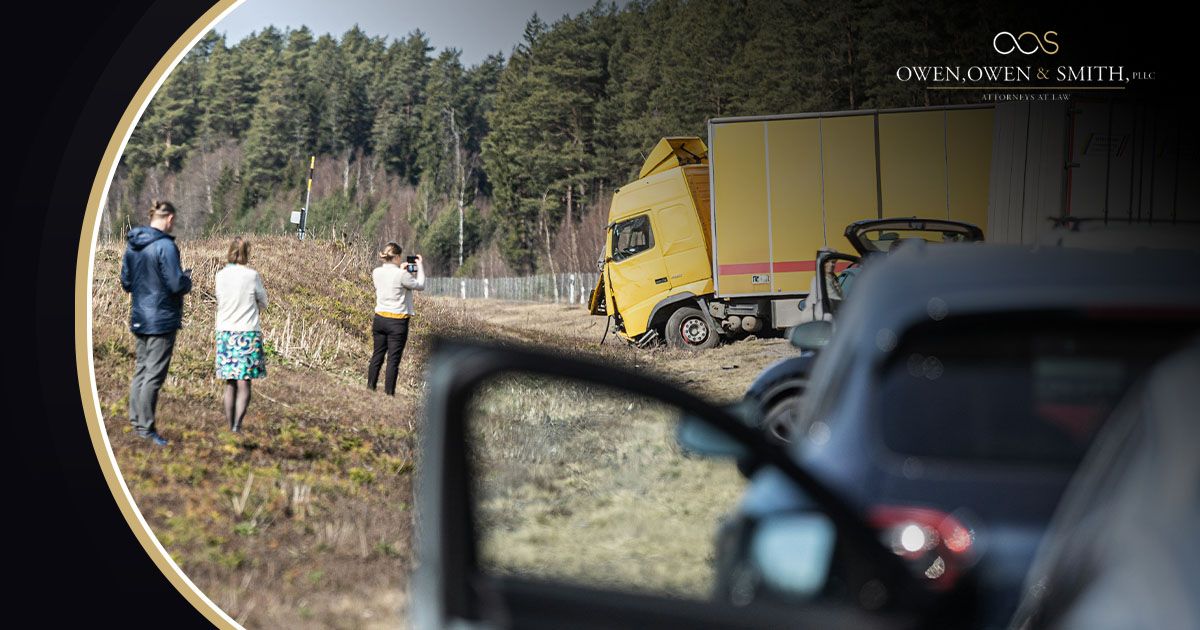
A jackknife accident happens when the trailer of a semi-truck swings out and starts folding toward the cab, almost like a pocketknife closing.
That’s the technical definition, but on the road, it’s a lot more frightening. The truck stops moving like a single unit; the trailer keeps pushing forward or sliding sideways, and the whole rig can suddenly spread across lanes in seconds.
That’s what makes these truck accidents so dangerous.
A semi-truck carries enormous weight and momentum, so when the trailer breaks loose, it can sweep into traffic, crush smaller vehicles, and trigger a pileup before anyone nearby has time to react. Accident claims involving a jackknife truck also tend to be more technical than people expect.
This usually isn’t just a story about a truck sliding in the rain; it’s about what caused the trailer to lose alignment in the first place.
That evidence often comes from brake-maintenance logs, cargo records, inspection reports, black-box data, dashcam footage, and skid-mark analysis, not just from quick opinions at the crash scene.
Defining the Jackknife Truck Accident
In simple terms, a jackknife is when the trailer stops following the cab and starts trying to pass it.
That happens because of physics, not bad luck. A tractor-trailer has a pivot point where the trailer connects to the tractor, and that hinge is what lets the vehicle turn. Under normal conditions, it works the way it should. But the truck loses traction, or braking becomes uneven, that same hinge can become the point at which control breaks down.
The tractor slows, changes direction, or loses grip, while the trailer keeps pushing ahead. Once that angle opens up, things can get worse very quickly.
Heavy braking is a common trigger. So is wet pavement, entering a curve too fast, steering too sharply, or dealing with poorly maintained brakes. If the rig is already overloaded or unstable, even one bad decision can set the whole thing off. That’s why commercial vehicle braking systems matter so much in these cases.
Sometimes the real cause has been building for weeks.
People often assume these crashes are just weather-related. They usually aren’t. Rain may expose the weakness, but something mechanical, operational, or human is often the real cause.
The Role of Improper Cargo Loading
Improper cargo loading plays a major role in many jackknife crashes because it changes the trailer’s weight distribution. If the load is unstable, too heavy in the wrong area, poorly secured, or shifting during travel, the trailer can be much harder to control during braking or turns.
That’s a bigger deal than it sounds.
The trailer isn’t passive. In a jackknife, it’s an active force in the crash. When the driver brakes, the cargo’s weight shifts forward. If the cargo is already uneven or unstable, that movement can change the rig’s balance at exactly the wrong moment. A rear-heavy trailer may shove the tractor. A top-heavy load may make the trailer more likely to swing. A shifting load can change the center of gravity mid-event, which is bad news in any emergency maneuver.
This is another reason why tractor-trailer crashes often require deeper investigation than standard car wrecks. The issue may have started before the truck ever left the loading yard.
If the freight was overloaded, badly distributed, or secured with incorrect equipment, accident risk was already built into the trip. Federal cargo securement rules require that freight be loaded and secured per specific guidelines, so it stays in place during normal driving and foreseeable emergency conditions.
In practice, that means lawyers and investigators may want far more than the police report. They may need scale tickets, bills of lading, loading instructions, cargo photos, tiedown records, and warehouse documentation.
Frankly, this is where some truck cases can get a lot more complicated. The driver may not be the only one at fault.
The shipper, loading crew, maintenance team, or carrier may all be part of the problem.
Determining Liability in Multi-Vehicle Truck Crashes
Liability in a multi-vehicle jackknife crash depends on what failure started the chain reaction and who had control over that failure. That is the real issue in truck accident liability in Mississippi.
The truck may be the most visible part of the wreck, but visibility and legal fault aren’t always the same thing.
A jackknife crash can block several lanes almost instantly. While one car may hit the trailer broadside, another might slam into stopped traffic or slide under the trailer, creating a serious risk of underride. By the time the dust settles, several impacts may have happened in just a few seconds. That’s why crash sequence reconstruction is so important in these cases.
Investigators need to know who hit what, in what order, and why, because liability can fall on more than one party. That happens quite often in truck cases.
That’s how trucking company negligence comes into focus. If the maintenance logs show skipped service, if the driver had reported defects, or if dispatch records show there was pressure on the driver to drive too fast or too long, the case stops looking like a random loss-of-control event.
It starts looking preventable.
Severe Injuries Associated With Jackknife Collisions
Jackknife collisions cause severe injuries because the trailer creates a broad, sweeping impact path, often leading to multiple crashes in one event.
A passenger vehicle doesn’t have to hit the front of the truck to be devastated. It can be struck by the side of the trailer, crushed against a barrier, pushed into another car, or trapped underneath the trailer.
The injuries that often result from a jackknife accident can be extremely serious because of the size mismatch alone. National crash data consistently shows that those in smaller vehicles typically suffer the most harm in large truck collisions.
Common severe injuries include:
- Paralysis
- Crush injuries
- Fractures and broken bones
- Internal bleeding
- Organ damage
- Severe burns in fire-related crashes
These wrecks aren’t just minor-impact collisions with inflated claims. When a trailer sweeps across traffic, it’s like a fast-moving wall crushing everything in its path.
The consequences are often exactly as bad as that sounds.
Owen, Owen & Smith PLLC Advocates for Truck Accident Victims
If you really want to understand a jackknife accident, you have to look past the dramatic image of the folded trailer and ask harder questions.
Were the brakes properly maintained? Did the cargo shift? Did the trailer have enough traction? Did the driver react badly, or was the truck already unstable? Did the company ignore FMCSA safety regulations or miss warning signs in the maintenance records?
Because those answers usually decide the case.
That’s why these cases demand a detailed investigation, and why technical proof matters so much.
At Owen, Owen & Smith PLLC our Mississippi truck accident lawyers know how to find that proof and use it to show what really caused the crash.